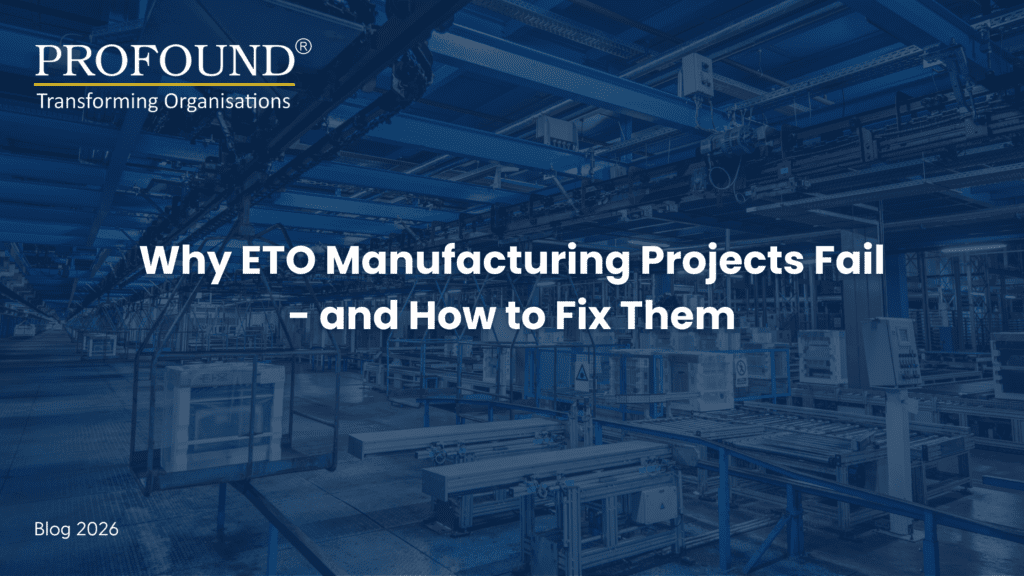
Engineer-to-Order (ETO) manufacturing sits at the most challenging end of industrial execution.
Every order is unique. Engineering is intense. Dependencies are fragile. Customers want speed, customization, and certainty — all at once.
Yet across capital equipment, heavy engineering, EPC, special machinery, and defense sectors, the pattern is remarkably consistent:
- Projects run late
- Margins erode silently
- Engineering is overloaded
- PPC is asynchronous
- Shop floors are always expediting
- Cash is trapped in WIP
This is why engineer-to-order consulting engagements often start after performance has already deteriorated.
The uncomfortable truth is this:
ETO projects don’t fail because they are complex.
They fail because they are managed using logic meant for repetitive environments.
1. The Core Problem: ETO Is a Flow Problem, Not a Cost Problem
Most ETO organizations manage performance through:
- Departmental efficiency
- Cost variances
- Utilization targets
- Milestone compliance
In reality, ETO success depends on flow from design to delivery.
Profound Consulting’s Insight
Every system is limited by a small number of constraints. In ETO environments, the constraint is usually:
- Engineering capacity
- Critical specialists
- Integration points
- Or decision approvals
Optimizing everything except the constraint guarantees poor global results.
Fix: Engineer-to-Order Process Optimization
- Identify the true system constraint
- Protect and exploit it
- Subordinate all other functions to its pace
- Measure throughput, not local efficiency
This is the foundation of effective ETO manufacturing consulting in India, where demand volatility and customization are especially high.
2. Why Traditional Project Planning Fails in ETO
Most ETO projects are planned using:
- CPM schedules
- Individually “safe” task durations
- Aggressive delivery commitments
Yet delays are the norm.
Profound Consulting practices the principles of a highly effective project management methodology called Critical Chain Project Management (CCPM) which is one of the application of Theory of Constraints (TOC).
Critical Chain Project Management (CCPM) shows that:
- Task-level safety is wasted
- Multitasking destroys focus
- Dependencies amplify delays
- Projects fail late, with no early warning
Practical CCPM Example
In a custom equipment project:
- Engineering tasks are estimated at 20 days “to be safe”
- Actual focused effort is only 10–12 days. The touch time.
- But engineers multitask across 5 projects
Result: Every task finishes late — even though no one is idle.
Fix: Sales-to-Delivery Optimization Using CCPM
- Management and Sales to provide early visibility & priority to the cross functional team on the project pipeline, to avoid late pressure on the CFT
- Abolish bad multitasking
- Stop starting projects without all necessary inputs are available (Full Kit)
- Remove safety from individual tasks
- Pool safety into project buffers
- Introduce feeding buffers for non-critical paths
- Track buffer consumption, not task completion %
This creates early warning and execution discipline across the entire ETO lifecycle.
3. Engineering Is the Hidden Constraint — and Is Almost Always Mismanaged
In most ETO companies:
- Engineering supports too many projects
- Priorities change daily
- Design freezes are violated frequently
- Manufacturing waits or reworks
Engineering is treated as a support function, not the system constraint.
Diagnosis
If engineering output is unstable, everything downstream collapses:
- Procurement orders wrong or late materials
- Manufacturing builds incomplete assemblies
- Projects consume buffers prematurely
Fix: Constraint-Driven Engineering Management
- Limit engineering WIP
- Sequence projects explicitly
- Freeze designs at the right point
- Allow changes only through buffer-based decisions
This is a core lever in complex project execution improvement.
4. Multitasking: The Silent Killer of ETO Lead Time
ETO organizations often pride themselves on being “busy”.
Unfortunately, busy is not productive.
Profound Consulting’s Insight
When engineers, planners, buyers, and supervisors multitask:
- Task duration increases
- Errors increase
- Coordination losses explode
- Lead time stretches invisibly
Practical Fix
- One critical task per resource at a time
- Stagger project release (rope mechanism)
- Finish fast, then move on
- Measure completion velocity, not hours utilized
This single change often cuts project lead time by 30–40% without adding resources.
5. Why ETO Projects Drain Cash Even with Full Order Books
Many ETO companies are profitable on paper — yet cash-starved.
Cash Logic
Cash is trapped in:
- Partially engineered designs
- Early material purchases
- Half-built assemblies
- Waiting approvals and inspections
Fix: Cash Velocity
- Reduce project WIP
- Align billing milestones with constraint completion
- Accelerate early-stage engineering flow
- Shorten the cash-to-cash cycle through buffer control
This is where design-to-delivery optimization directly improves ROCE.
6. What Profound Consulting delivers
Before
- Long, unreliable lead times
- Constant expediting
- Firefighting culture
- Late surprises
After
- Shorter, reliable delivery promises
- Stable engineering flow
- Predictable shop floor execution
- Early warning through buffer health
- Higher throughput with the same resources
Typical results seen in structured engineer-to-order consulting transformations:
- 30–50% reduction in project lead time
- 2–3× improvement in on-time delivery
- 20–40% WIP reduction
- Significant ROCE and cash-flow improvement
My final take
ETO manufacturing is not broken.
The management logic applied to it is.
When ETO companies adopt a structured project management methodology:
- Complexity becomes manageable
- Execution becomes predictable
- Growth stops creating chaos
The goal is not to control every task —
It is to control flow from order to cash.
That is the real promise of engineer-to-order process optimization and world-class ETO manufacturing consulting in India.
If your ETO business is struggling with delays, cash blockages, or execution chaos, connect with Profound Consulting at +91 9922416826 or write to info@profoundconsulting.in to implement structured, flow-driven project management that turns complexity into predictability.
Q 1. What is engineer-to-order (ETO) manufacturing?
Engineer-to-order (ETO) manufacturing is a production model where products are fully engineered and customized after receiving a customer order. Each project is unique, making engineering capacity, coordination, and execution flow critical to success.
Q 2. Why do most engineer-to-order projects fail?
ETO projects fail mainly due to poor flow management, not complexity. Common causes include engineering overload, excessive multitasking, weak project prioritization, delayed decision-making, and planning methods designed for repetitive manufacturing environments.
Q 3. How does engineer-to-order consulting improve project performance?
Engineer-to-order consulting improves performance by optimizing flow from design to delivery. This includes identifying system constraints, reducing multitasking, applying Critical Chain Project Management (CCPM), stabilizing engineering output, and improving throughput, delivery reliability, and cash flow.
Q 4. What is engineer-to-order process optimization?
Engineer-to-order process optimization focuses on managing constraints, reducing work-in-progress (WIP), synchronizing engineering and manufacturing, and measuring throughput instead of local efficiency. This approach enables predictable execution even in complex, customized projects.
Q 5. Why is engineering the biggest constraint in ETO manufacturing?
In ETO environments, engineering is often the primary constraint because it supports multiple projects simultaneously, faces frequent priority changes, and absorbs design changes. When engineering flow is unstable, procurement, manufacturing, and delivery timelines collapse.