

That spike in orders every June, September, December & March? It’s not growth. It’s a warning signal hiding in plain sight.
I walked into a mid-sized auto-components manufacturer three days before quarter-end. The plant was humming at 130% capacity. The dispatch bay looked like a war zone — forklifts weaving between stacks of finished goods, supervisors talking into walkie-talkies. Trucks were being loaded for customers who, I later discovered, hadn’t actually confirmed deliveries.
The sales team was celebrating. They were on track to hit their quarterly number.
Subsequently, in the third week of the next month. The plant was almost silent. Overtime had been replaced by a two-day shutdown. The very same customers who received those trucks were now calling to delay the next quarter’s orders because their warehouses were full.
That’s Quarter-End Sales Syndrome in its full, painful glory.
What Exactly Is Quarter-End Sales Syndrome?
Quarter-End Sales Syndrome (QSS) is the pattern where a disproportionate share of monthly or quarterly revenue is booked in the final days of a reporting period — driven not by genuine customer demand, but by internal pressure to meet targets. It goes by many names: end-of-quarter push, hockey stick revenue pattern, sales sandbagging, and in its more aggressive forms, channel stuffing.
It is endemic across industries. In manufacturing, it’s particularly damaging because the physical act of producing and shipping goods has real costs — labor, logistics, quality compromises, and downstream disruption — that a booking entry in a CRM does not. Most importantly the raw material which gets consumed for unwanted finished goods rather than the ones which get sold, which has demand.
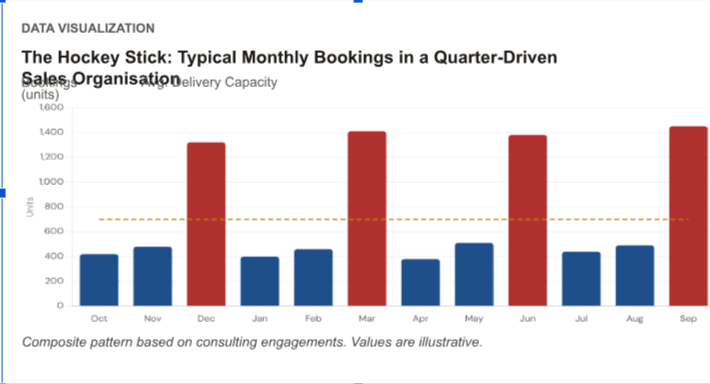
The Mechanics: How It Spirals
QSS doesn’t happen because salespeople are lazy or dishonest. It happens because the incentive system is designed to produce exactly this outcome. Most sales incentive structures in Indian manufacturing reward quarterly attainment — a binary measure of “did you hit the number?” This creates a predictable behavioural pattern:
1. Sandbagging Early in the Quarter
Customers who are ready to buy in Month 1 are asked to “hold the PO until next quarter” so the rep can start the next period with a cushion.
2.Discounting to Pull Demand Forward
As Month 3 approaches, reps offer
end-of-quarter discounts, extended payment terms, or free freight to close deals that weren’t naturally ready. Margin erodes.
3.Production Scramble
The plant receives a 45-day order book crammed into 15 days. Overtime surges, quality shortcuts are taken, changeover efficiency drops.
4.Demand Hole in Month 1 of Next Quarter
Customers’ warehouses are full. Calls to delay, reschedule, or cancel arrive. The sales team has nothing in the funnel because it was all pulled forward. The cycle restarts.
The Real Cost: Let’s Run the Numbers
Most companies measure QSSS by its top-line benefit: “We hit our ₹75 Cr quarter.” What they don’t measure are the hidden costs eating into the bottom line. Here’s a realized composite from a ~Rs.400 Cr / year manufacturer I consulted.
Impact Analysis: One Quarter:
| Revenue booked in Q-end push | 17,00,00,000 |
| Average discount given to close deals (13.80%) | (2,34,60,000) |
| Additional expenses incurred to close deals | (85,00,000) |
| Net Margin Impact Vs. Steady Sate Quarter | (3,19,60,000) |
The Brutal Truth:
In this case, the company celebrated hitting their quarterly target of Rs.65 Cr in bookings. The net cost of achieving it that way was Rs.3.86 Cr — a margin destruction of 19% on that increment of revenue. The quarter looked great on a revenue dashboard. The P&L told a different story.
The Bullwhip Effect: Manufacturing’s wrong practice
When distorted demand signals ripple upstream through a supply chain: the Bullwhip Effect occurs. In manufacturing, QSS is one of its most reliable triggers.
Here’s how it plays out for a components manufacturer supplying Tier-1 auto OEMs:
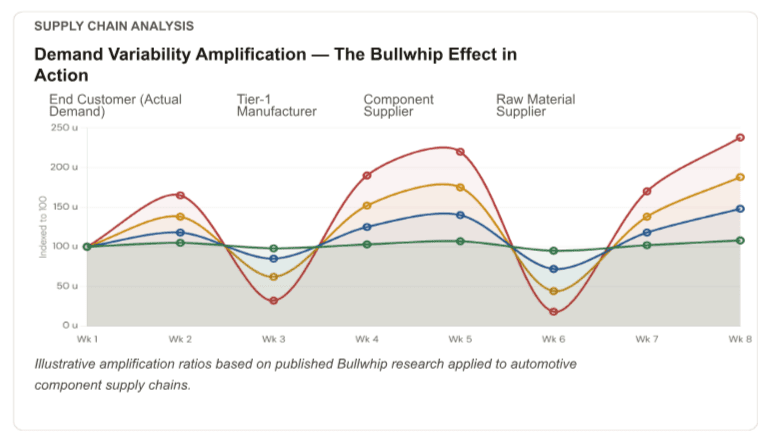
A 15% swing in end-customer demand — completely manageable — becomes a 60%+ swing in raw material orders by the time it reaches your steel or polymer supplier.
Your supplier then over-orders to protect themselves. Lead times increases. You build safety stock. Working capital swells. And the entire supply chain gets more brittle with every passing quarter.
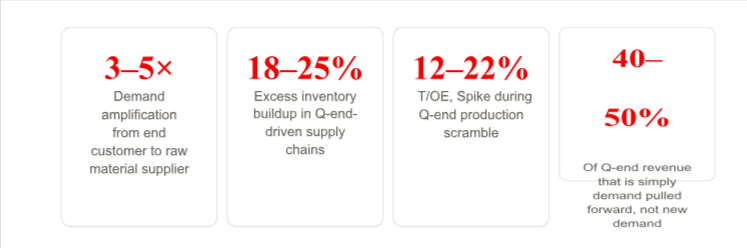
In most QSSS-afflicted companies, the constraint is not production capacity, procurement lead time, or even the sales funnel.
The constraint is the measurement system itself.
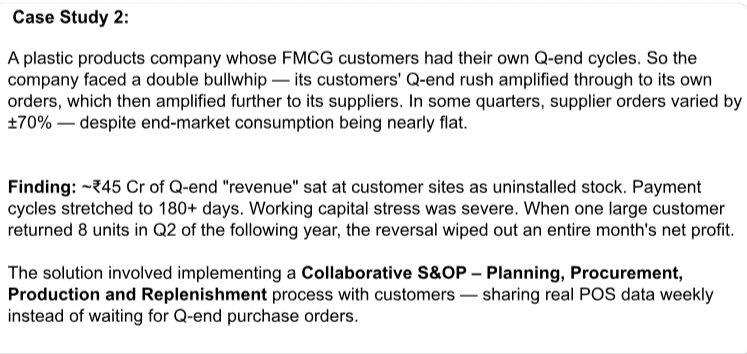
Case Studies:
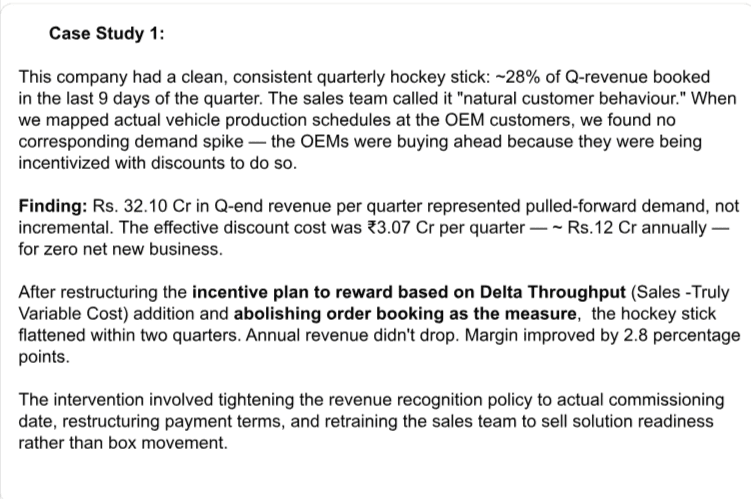
The Human Cost Nobody Puts in a Spreadsheet
Every number above is quantifiable. But there’s a cost that doesn’t show up in any management accounting report: the toll on people.
The production supervisor who hasn’t had a full weekend in six weeks because Q-end always means weekend shifts. The quality engineer who signs off on borderline parts because “we need to ship tonight.” The sales manager who genuinely believes she’s doing a great job because her number is green — while slowly burning out her customer relationships with constant pressure tactics. The procurement officer who can’t get consistent pricing from suppliers because his order pattern looks erratic and unreliable.
Sales-driven burnout and operational attrition are real, measurable phenomena. In manufacturing, where skilled operators and experienced engineers take years to develop, this human cost compounds into a genuine competitive disadvantage.
T H E I R O N Y:
The very behaviours that create Q-end syndrome — sandbagging, late-quarter discounting, rushed shipments — are rational responses to an irrational incentive system. Fix the system, and the behaviours change. Blame the people, and you’ve solved nothing.
What To Do Instead: 7 Step Direction of Solution
I want to be clear: I’m not suggesting you eliminate quarterly targets or that sales urgency is inherently bad. The goal is to restructure the incentives and operational rhythms so that urgency drives genuine customer value creation — not just period-end bookings.
1. Shift to Rolling Weekly Revenue, Throughput & Throughput / Operating expense Tracking. Replace the hard quarterly cutoff with a weekly view in your sales dashboards. This reduces the psychological pressure of “month end” or “quarter-end” as a cliff and encourages consistent weekly deal velocity.
Demand smoothing starts with how you measure.
2.Redesign Sales Incentive Structures. Move to a Delta Throughput based Incentive structure. deal velocity, Throughput per order.
3.Price Integrity Policies. Establish a formal discount approval matrix based on absolute throughput, Throughput % that requires CFO to sign-off for any discount which is beyond walk away throughput & T% .
4.Implement Demand-Driven Sales & Operations Planning (S&OP). Run daily S&OP that uses real customer consumption data (not purchase orders) as the demand signal. Integrate with your customers’ production schedules where possible. This eliminates the guesswork that feeds the bullwhip.
5.Decouple Production from Billing Cycles. Your production schedule should be driven by a master production schedule (MPS) based on replenishment signals from Inventory buffers, not by the despatch urgency of the last week of the quarter. If your MPS and your billing cycle are perfectly correlated, that’s a red flag.
6.Measure and Publish the True Cost of QSS. Most leadership teams tolerate the Q-end push because they’ve never seen its actual cost quantified. Run the analysis I showed earlier — discount given, Delta operating expenses — and present it quarterly alongside the revenue number. Visible costs get managed.
7.Apply TOC’s Drum-Buffer-Rope Scheduling. If production is your true bottleneck, use Drum-Buffer-Rope (DBR) to protect your constraint from the erratic demand caused by QSS. The “drum” (your constraint) sets the pace. Buffers absorb variability. Ropes synchronize the rest. A well-implemented DBR system makes the Q-end scramble structurally impossible.
Closing remarks
Quarter-End Sales Syndrome is not a sales problem. It’s a systems problem. It persists because organisations measure outputs (quarterly revenue) rather than the health of the system that produces those outputs (customer demand quality, margin consistency, operational load balance, supply chain trust).
The manufacturers I’ve seen break this pattern, they don’t do it by working harder at quarter-end. They do it by making quarter-end irrelevant — by building sales and operational rhythms that are indifferent to the calendar, driven instead by real customer value creation.
The next time your Q-end is looking strong, I’d encourage you to ask one question before you celebrate: Is this demand we created, or demand we borrowed from next quarter?
If you are keen on evaluating your business, sales & operations, you can reach out to me on info@profoundconsulting.in. web: www.profoundconsulting.in