A practical guide for manufacturing leaders who want work to move faster — and stop getting stuck
The problem hiding in plain sight
In most manufacturing companies I work with, the organization chart looks clean. Sales report to one head, Purchasing reports to one. Production to another. Quality, Finance, Dispatch — all in their own neat boxes.
But when I trace how an actual order moves through the business — from customer inquiry to delivery — it rarely follows that clean chart. Instead, it zigzags. It waits. It gets handed off, re-explained, re-checked, and sometimes lost entirely between departments.
That’s the silo problem. And it’s costing you more than you think.
Two ways to organize work
Let me show you the fundamental difference with a visual.
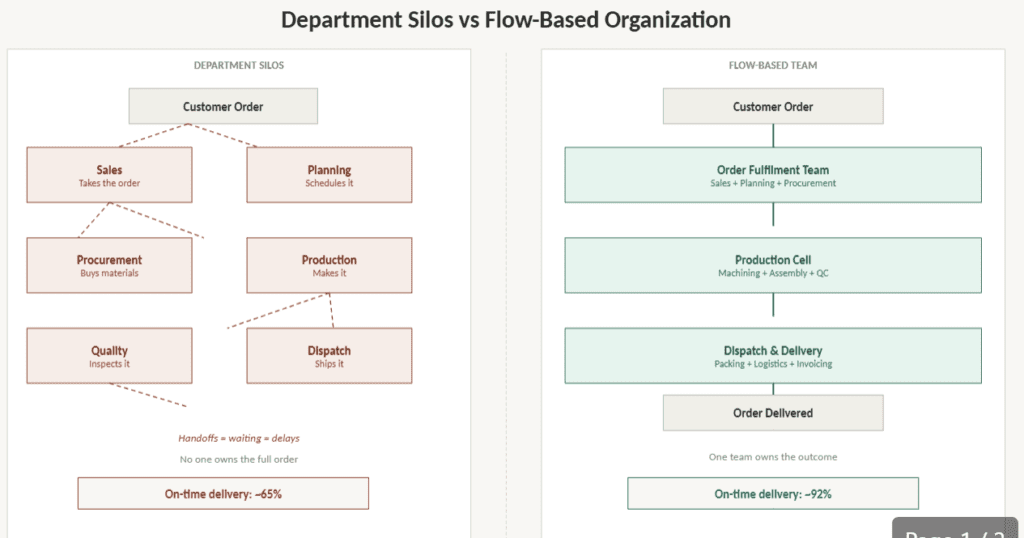
On the left, each department does its job well — but nobody owns the full journey of an order. Work gets handed off, waits in queues, and ges re-explained at every boundary.
On the right, a cross-functional team is built around the flow of work. The order moves cleanly from one stage to the next, with one team accountable for the outcome.
Example from one of my consulting engagements: Industrial & Automotive products manufacturing MNC
Initially, delivery performance was at 61%. Leadership blamed production. Production blamed procurement. Procurement blamed planning. Sound familiar?
When we mapped the actual journey of a production order, we found it passed through 22 different people across 6 departments before the first component was even worked upon. The total elapsed time from order receipt to production start: 9 days. The actual work done in those 9 days: about 4 hours.
The rest was waiting — waiting for someone to open an email, attend a meeting, or give an approval.
We restructured the business into three flow-based teams:
- Order Fulfilment (Sales + Planning + Customer Service)
- Production Cell (Machining + Processing + Assembly + In-process QC)
- Outbound Fulfilment (Final QC + Packing + Dispatch + Invoicing)
Within four months, delivery performance moved to 87%. Within eight months, it crossed 93%. Nothing changed in terms of equipment or workforce size. Only the structure changed.
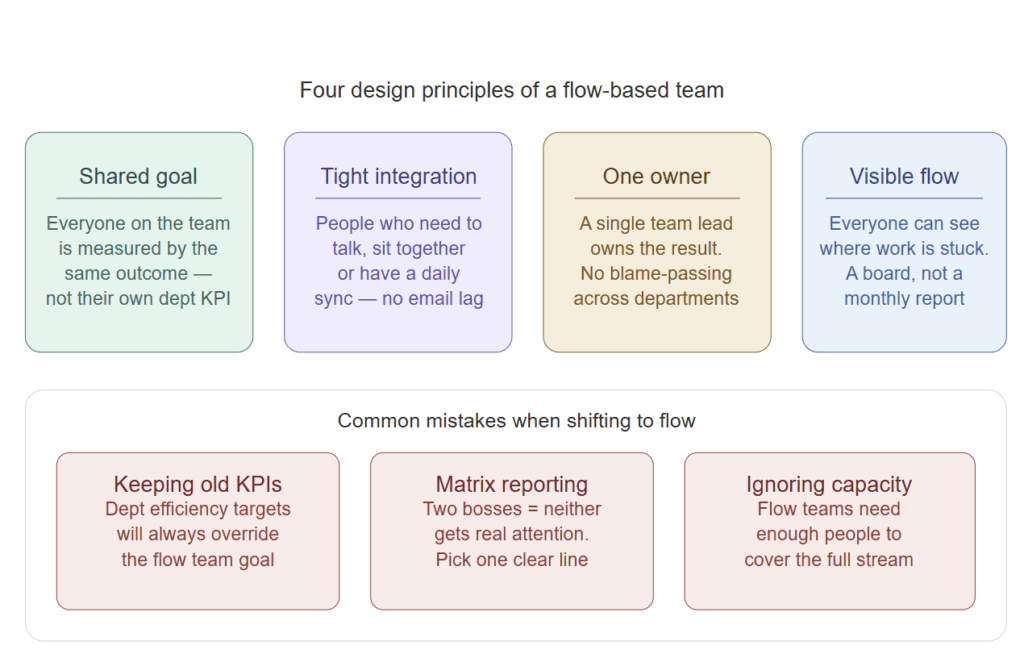
What makes a flow team different?
Here’s how to think about designing one.
Another example: a plastic products manufacturing company
They had a different problem. Their quality rejection rate at dispatch was high, but the defects were being caught too late. By the time Quality flagged an issue, the component had already gone through three more operations.
The problem was structural. Quality sat in its own department. They received parts, inspected them, and sent reports. No one in production owned quality as part of their daily job.
We embedded quality into the production processes. The line operator and the quality technician now share the same team leader, the same daily target, and the same board. Defects started getting caught at the source — often in the same shift. Rework costs dropped by 38% in six months.
How to start — without blowing everything up
You don’t need to restructure the entire company overnight. Here’s a practical path:
Step 1 — Pick one value stream. Choose the product family or customer segment that causes you the most pain. Map every step from order to delivery. Count the handoffs.
Step 2 — Build one pilot flow team. Take the people who work on that stream and create a temporary cross-functional team. Give them one shared target — usually on-time delivery or lead time.
Step 3 — Run it for 90 days. Measure before and after. Let the results make the argument for you. In my experience, pilot teams almost always show improvement within the first month — simply because people who were emailing each other are now sitting together.
Step 4 — Scale selectively. Not every function needs to be reorganized. Finance, HR, and engineering can remain centralized and serve as internal support to the flow teams. The goal is to organize the work-doing parts of the business around flow.
The hard truth
The biggest barrier to flow-based design is not structural — it’s ownership. Department heads lose headcount. Functional reporting lines get disrupted. Specialists worry about career paths outside their professional silos.
These are real concerns that need real attention. In every engagement where we’ve successfully made this shift, the leadership team committed to three things: transparent communication about what’s changing and why, career paths that don’t depend on departmental headcount, and patience through the first 00 days of discomfort.
The companies that got through those 90 days all said the same thing afterward: “We should have done this years ago.”
If you’d like to assess how flow-based your current operations are, or want help designing a pilot value stream, feel free to reach out on info@profoundconsulting.in